Shaoyang Guo郭绍阳

Physics undergraduate at Peking University. Research intern at ByteDance Seed. Working on VLM post-training, STEM reasoning evaluation, and data-centric AI.

Peking University, School of Physics (Class of 2027) Excellence Program · CPhO Gold Medalist
Physics of AI Embodied Intelligence VLM
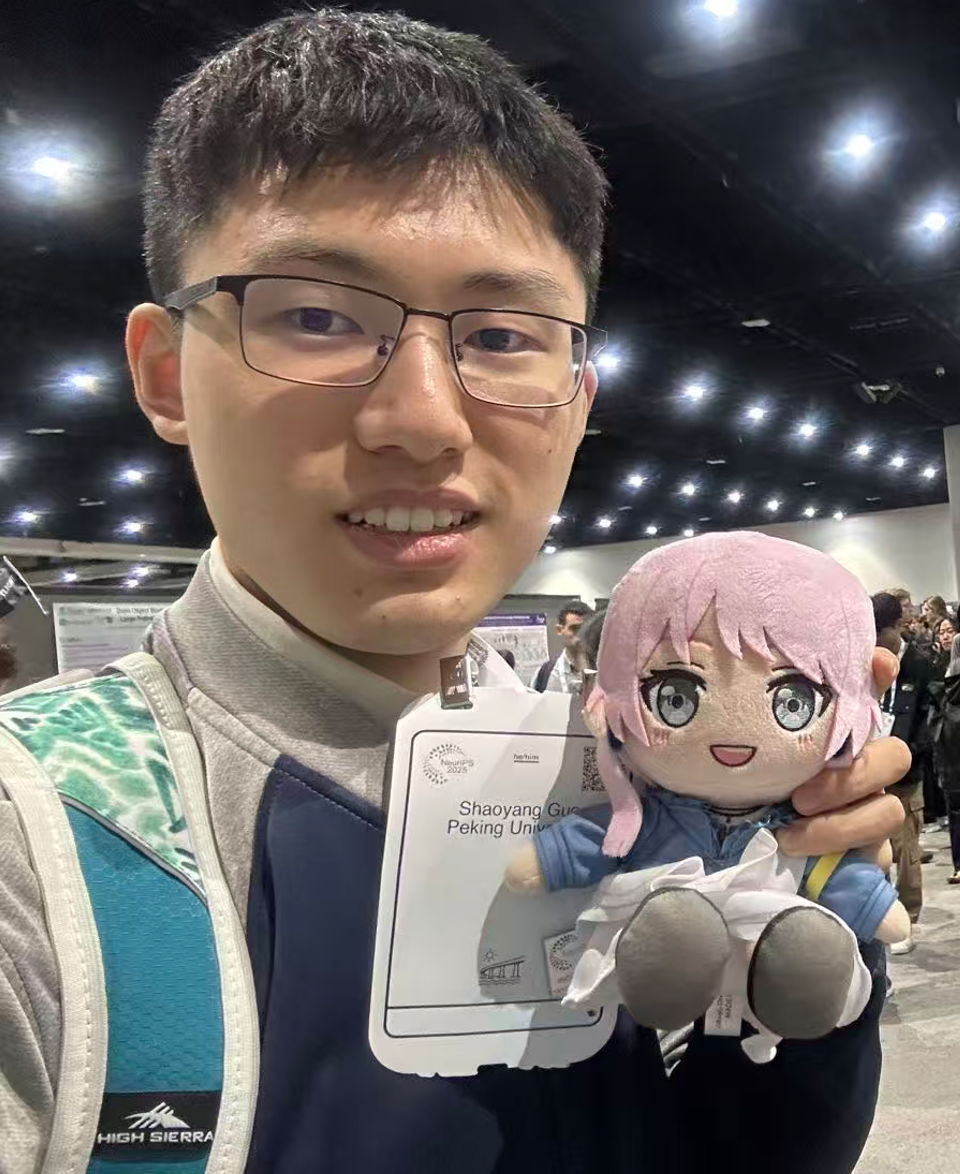
Shaoyang Guo at NeurIPS 2025

News

2025.07 Joined ByteDance Seed as research intern, VLM post-training team.
2025.04 PHYBench preprint released on arXiv. Submitted to NeurIPS 2025.
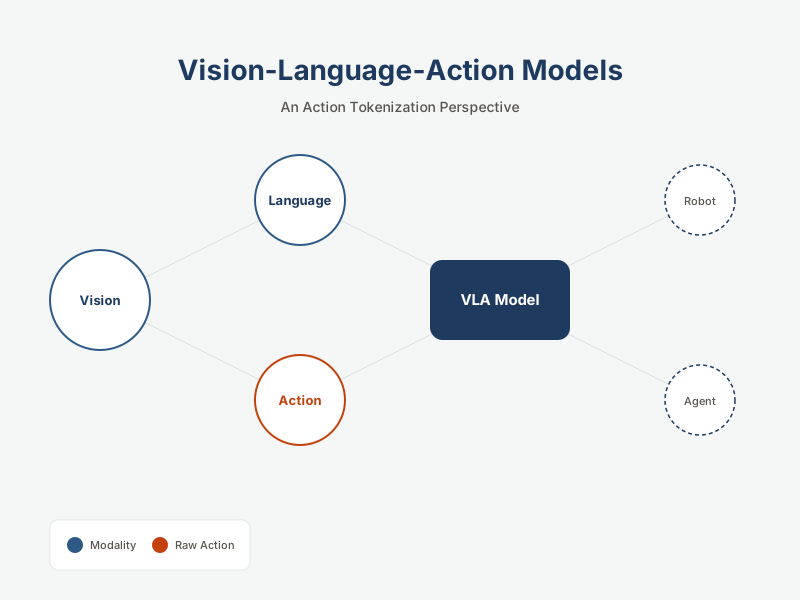
2025.03 Started contributing to VLA models survey (action tokenization perspective).
2024.12 Awarded National Scholarship (top 1% at PKU).

Publications

PHYBench
NeurIPS 2025 (submitted)

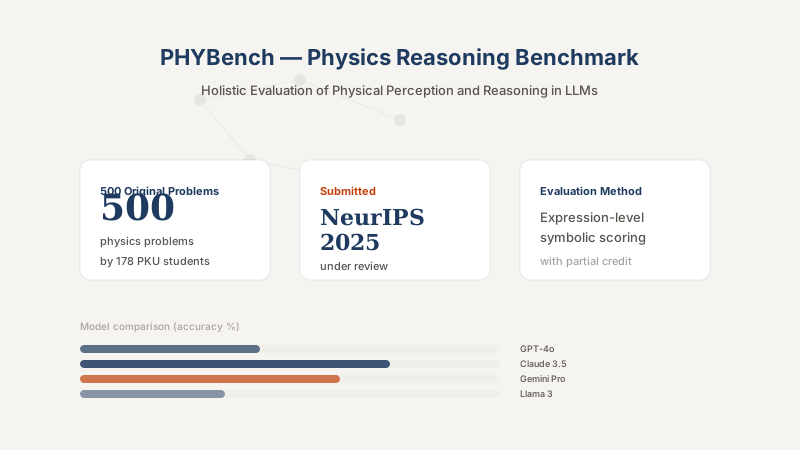
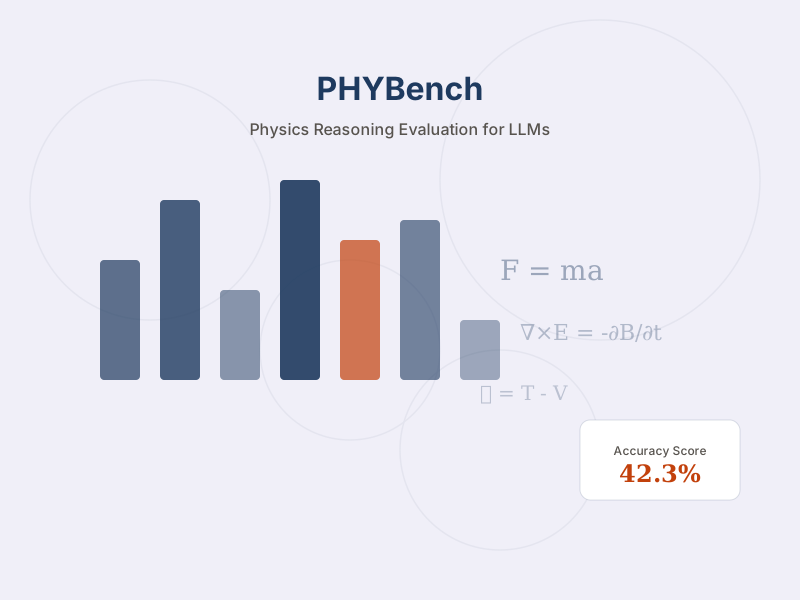
PHYBench: Holistic Evaluation of Physical Perception and Reasoning in Large Language Models

Shi Qiu*, Shaoyang Guo*, et al.

A comprehensive physics reasoning benchmark with 500 original problems contributed by 178 PKU students. Designed evaluation criteria and failure mode analysis for open-ended scientific reasoning.

VLA Survey
arXiv Preprint

A Survey on Vision-Language-Action Models: An Action Tokenization Perspective

Authors including Shaoyang Guo

A survey on VLA models focusing on action representation. Responsible for the Raw Action chapter, reviewing 30+ key papers on end-to-end VLA architectures.

Experience

Jul 2025 – Present

Research Intern, Seed VLM Post-Training Team

ByteDance

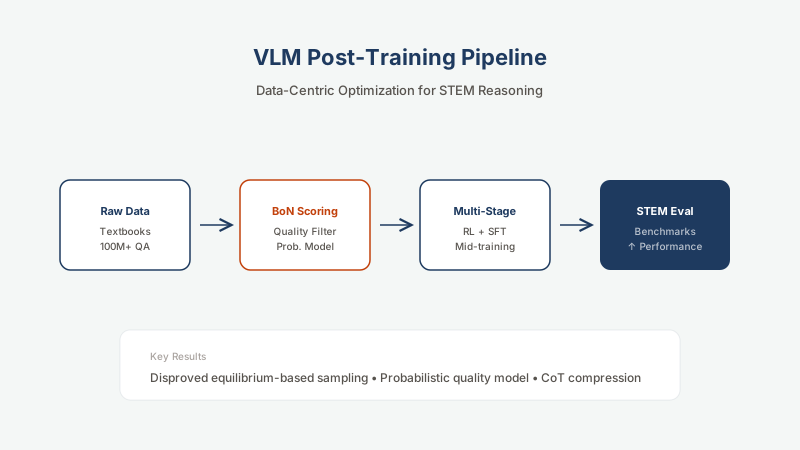
Working on multi-stage post-training for vision-language models, targeting STEM reasoning capabilities through RL, SFT, and mid-training.

  • Responsible for multi-stage delivery across RL, SFT, and mid-training; participated in early mid-training exploration.
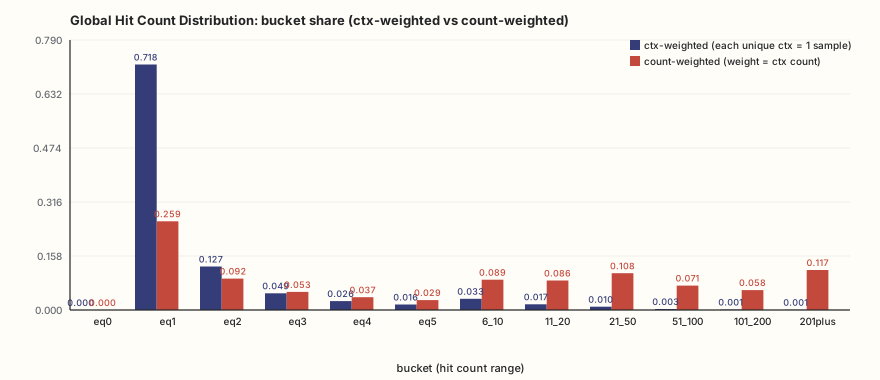
  • Researched BoN sampling and sample-repeat strategies; disproved equilibrium-based sampling assumptions; established RL–SFT equivalence under repeat conditions.
  • Developed large-scale data cleaning pipeline with probabilistic quality models; built textbook exercise extraction system (100M+ QA pairs).
  • Exploring TransferRL (combining SFT with RL) and CoT compression methods for efficient reasoning synthesis.
Feb 2025 – Sep 2025

Co-initiator & Co-first Author, PHYBench

Peking University (Eureka Lab)

Co-initiated and co-led PHYBench, a physics reasoning benchmark for LLMs. Paper submitted to NeurIPS 2025.

  • Identified gaps in existing LLM physics evaluation; led project from concept validation to full data pipeline.
  • Organized 178 PKU students to build 500 high-quality original physics problems in 2 weeks.
  • Designed evaluation criteria, quality control processes, and failure mode analysis frameworks.
  • Completed main experiments and analysis of frontier LLM performance across physics subdomains.
Mar 2025 – Aug 2025

Research Assistant, VLA Survey

PsiRobot Lab, Peking University

Co-authored a survey on Vision-Language-Action models. Advisor: Prof. Yaodong Yang.

  • Responsible for the Raw Action chapter; reviewed 30+ key papers on end-to-end VLA architectures.
  • Organized taxonomies for VLA model design from an action tokenization perspective.

Blogs

Ideas and working notes on AI, physics, and research taste.

What makes a STEM benchmark actually useful?
Planned Essay

What makes a STEM benchmark actually useful?

Notes on building evaluations that reveal real reasoning capability rather than benchmark-specific pattern matching, with lessons from PHYBench.

BenchmarkingPhysicsEvaluation
Draft coming soon
Views on large model training
Writing Plan

Views on large model training

A continuing series for organizing personal views on post-training, data quality, RL/SFT dynamics, and the practical craft of making models better.

Post-TrainingData QualityVLM
Draft coming soon
From physics olympiad to AI research
Personal Note

From physics olympiad to AI research

Reflections on how physics training shapes taste in AI research: problem selection, abstraction, experiments, and long-term curiosity.

ResearchPhysicsPersonal
Draft coming soon

Education & Honors

Peking University, School of Physics

B.S. in Physics (expected 2027). Admitted via Excellence Program (CPhO Gold Medal). Top 10% in first-year physics cohort. Completed 141/149 credits by sophomore year including 3 graduate courses.

National Scholarship (2024)

Ministry of Education, top 1% at Peking University.

Chinese Physics Olympiad Gold Medal

National rank #57 (2022). Admitted to PKU Physics via Excellence Program.

NOIP First Prize (2020)

National Olympiad in Informatics in Provinces.

Contact

Open to research collaboration, especially in VLM post-training, evaluation, and embodied intelligence.